By HRS Food · Published · Reviewed
What makes chocolate feel smooth or gritty?
The short answer
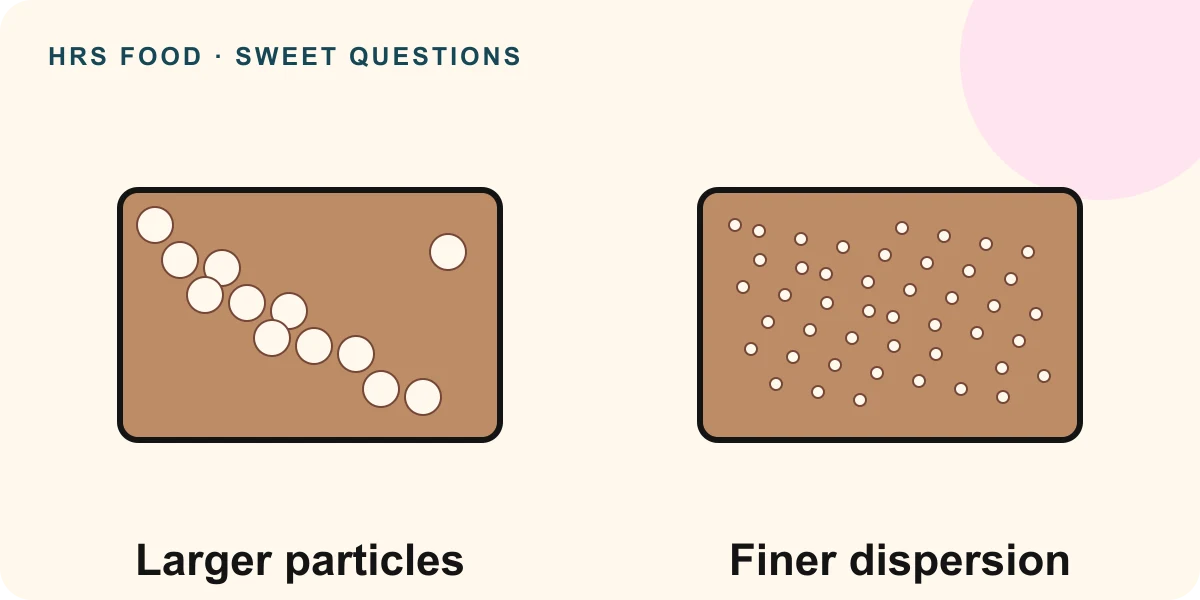
Chocolate feels smooth when its particles and fat phase work together to create a pleasing mouthfeel. Refining reduces particles; conching helps develop the mixture and its flow. Larger or poorly dispersed particles can feel gritty. Price alone does not guarantee smoothness, and a supermarket bar can be very smooth. [1]
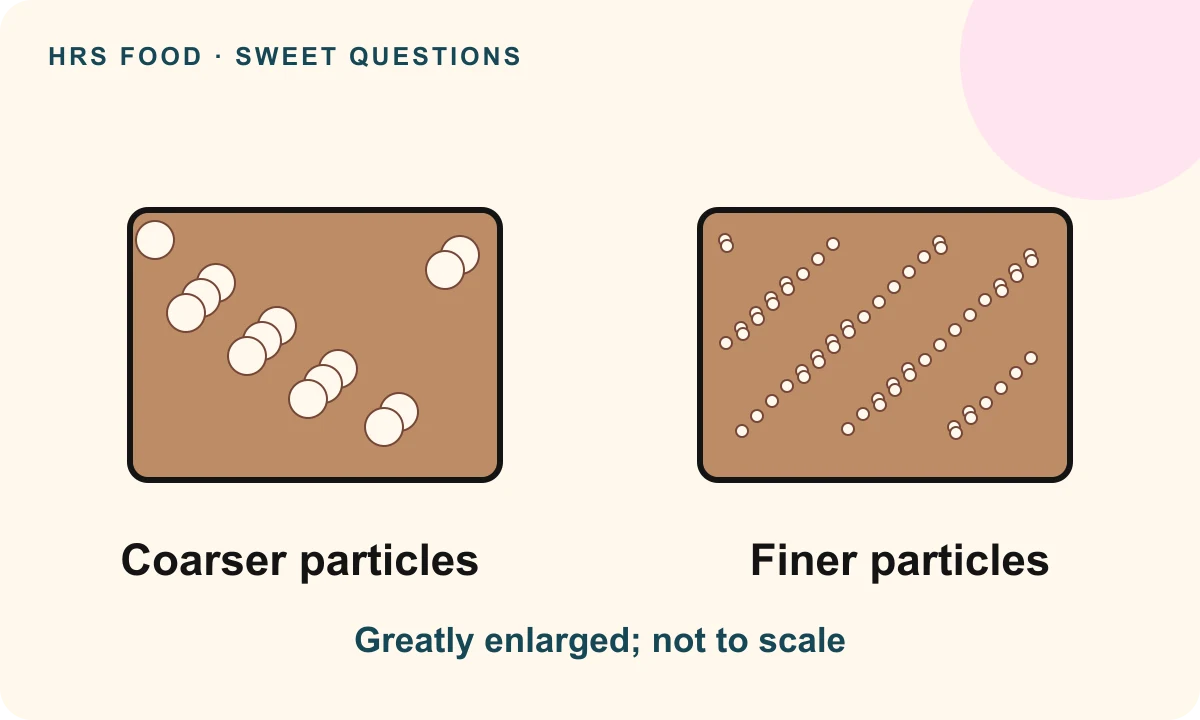
Your tongue can notice the solid particles
Chocolate contains solid particles dispersed through a fat-rich phase. Their size and distribution affect mouthfeel. Research comparing refining methods has examined these changes rather than treating chocolate as a completely dissolved liquid.
Think of a very fine suspension: reducing noticeable grains can make it feel more uniform, even though the finished chocolate still contains solid material. [1]
Refining and conching have related jobs
Refining reduces particle size. Conching works the chocolate mixture mechanically, helping develop how its ingredients are distributed and how it flows. In some equipment the operations overlap.
A study comparing six refining systems found differences in grittiness and other sensory attributes. This supports looking at manufacturing and formulation together, rather than assuming a long conching time alone is a smoothness score. [2]
Refine
Reduce and control particle size.
Work the mixture
Develop dispersion and flow during conching.
Taste
Particles and the fat phase shape the sensation.
How it works [1]
The surrounding fat matters too
Smoothness is not only about crushing every particle smaller. The cocoa-butter-rich continuous phase and the way particles interact also affect flow and mouthfeel. Primary conching research describes how mechanical work and dispersants change a dense mixture into a flowable suspension.
That is why two chocolates with similar particle sizes can still behave differently in your mouth. The recipe and how the mixture is developed both count. [3]
Compare mouthfeel without guessing from price
A higher price can reflect many things besides particle size or texture. You cannot read the size of cocoa particles from a wrapper, and a supermarket product is not automatically gritty.
Compare equivalent plain chocolates at a similar temperature. Notice grittiness, melting, thickness and waxiness separately from sweetness and flavour. A deliberately coarse style may also be a different preference, rather than an accidental defect. [2]
At a glance
| What you notice | What explains it |
|---|---|
| Grittiness | A particle-related sensation in the mouth. |
| Fluidity | How readily the chocolate mixture flows. |
| Price | Does not disclose particle size or guarantee smoothness. |
For the underlying explanation [2]
Common questions
Does more cocoa always mean smoother chocolate?
No. Cocoa percentage does not specify particle size, dispersion or every feature of the fat phase. [1]
Is conching simply grinding?
They can overlap in some equipment, but refining and conching describe different aspects of developing chocolate. [2]
Can budget chocolate be smooth?
Yes. Price is not a direct measurement of particle size or mouthfeel. [2]
Sources and how we checked
Written by HRS Food using the sources below. Information checked on . Product examples refer to the named declaration, not every brand or recipe. Use the current pack for ingredients and allergens.
- Tan and Balasubramanian: particle size and chocolate refining
- Primary study: refining systems and sensory properties
- Primary research: conching and flowable chocolate suspensions
Original HRS explanatory illustrations. Shapes and layouts are simplified to show the idea; they are not product photographs or manufacturing specifications.