By HRS Food · Reviewed
Why does chocolate melt in your hand but stay solid on a shelf?
The short answer
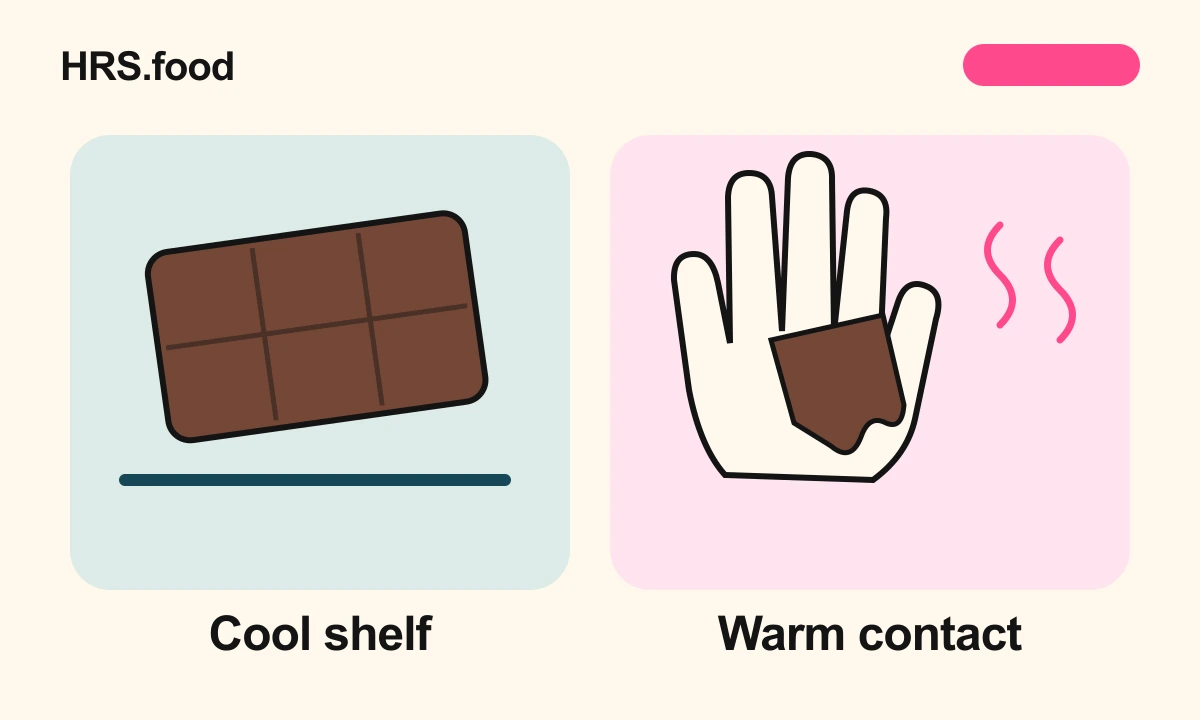
Chocolate stays firm on a cool shelf because its cocoa-butter fats remain sufficiently solid. A warm hand transfers heat into the chocolate, causing those fats to soften and melt. The change is not always instant: the recipe, thickness, starting temperature and length of contact all affect what happens. [1][3]
The useful ingredient is cocoa butter
Cocoa butter is the fat that gives chocolate much of its characteristic melting behaviour. Its fats can form different crystal arrangements, and those arrangements melt at different temperatures. Chocolate is therefore more complicated than a substance with one exact, universal melting point.
The Royal Society of Chemistry gives about 34°C for the desirable Type V cocoa-butter crystal form, which helps explain the familiar melt-in-the-mouth experience. That figure is a useful reference for the crystal form, not a guarantee that every complete chocolate bar becomes liquid at exactly 34°C. [4]
What does tempering do?
Tempering uses controlled heating and cooling to encourage a useful cocoa-butter crystal structure. Callebaut explains that good pre-crystallisation helps chocolate have gloss, a firm snap and suitable handling properties.
It does not give the chocolate a permanent heatproof shell. The same chocolate can be firm in a suitable room and soften when enough warmth reaches it. Tempering and keeping a bar cool solve related but different parts of the problem. [2]
Cool storage
Cocoa-butter crystals help the bar stay firm.
Warm contact
Heat moves from the hand into the chocolate.
Softening
Enough warmth changes the fat structure.
How it works [4]
Why your hand changes the result
A hand can be warmer than the chocolate it holds. Direct contact transfers warmth to the surface, so a small corner or thin piece may soften before the whole bar changes. Hold the piece longer and more of it can warm up.
Your skin is not always at your core body temperature, and people’s hands differ. That is why the statement that chocolate melts instantly in every hand is too absolute. A chilled, thick bar and a thin piece already sitting in a warm room will not behave identically. [1]
Can chocolate melt on a shop shelf too?
Yes. Shelves are not automatically safe from heat. Sunlight, a hot window or an overheated room can soften chocolate. Callebaut gives 12–18°C as ideal storage for pure chocolate, with dry conditions and protection from light and strong odours.
Follow the current product’s storage instructions, especially for filled chocolates. Avoid repeated temperature changes where possible. If refrigerating during hot weather, remember that condensation on returning to room temperature can affect the surface; keeping the product wrapped until it has warmed helps limit that problem. [3]
At a glance
| Condition | Why it matters |
|---|---|
| A thin piece | Less material has to warm up. |
| A warmer starting point | Less additional warmth may be needed to soften it. |
| Longer hand contact | More time for heat to move into the chocolate. |
For the underlying explanation [2]
Common questions
Is body temperature the melting point of chocolate?
No single number applies to every chocolate. Cocoa-butter crystal form, the full recipe and conditions affect how a bar softens and melts. [4]
Does tempering stop chocolate melting?
No. It encourages useful crystal structure, gloss and snap, but enough heat can still melt the chocolate. [2]
Should chocolate always go in the fridge?
Not automatically. Follow the pack’s instructions. Cool, dry storage is usually preferred, and condensation during temperature changes can affect the surface. [3]
Sources and how we checked
Written by HRS Food using the sources below. Information checked on . Product examples refer to the named declaration, not every brand or recipe. Use the current pack for ingredients and allergens.
- Royal Society of Chemistry: the science of melting chocolate
- Callebaut: different tempering methods and pre-crystallisation
- Callebaut: good chocolate storage practices
- American Chemical Society: cocoa-butter crystal forms and melting
Original HRS explanatory illustrations. Shapes and layouts are simplified to show the idea; they are not product photographs or manufacturing specifications.