By HRS Food · Published · Reviewed
Why does chocolate turn white? Fat bloom and sugar bloom explained
The short answer
A white or grey coating on chocolate is often bloom: a change involving cocoa butter or sugar at the surface. Fat bloom and sugar bloom have different causes. Storage conditions can bring them on, so chocolate does not have to be very old to develop them. A white appearance alone cannot establish food safety. [1]
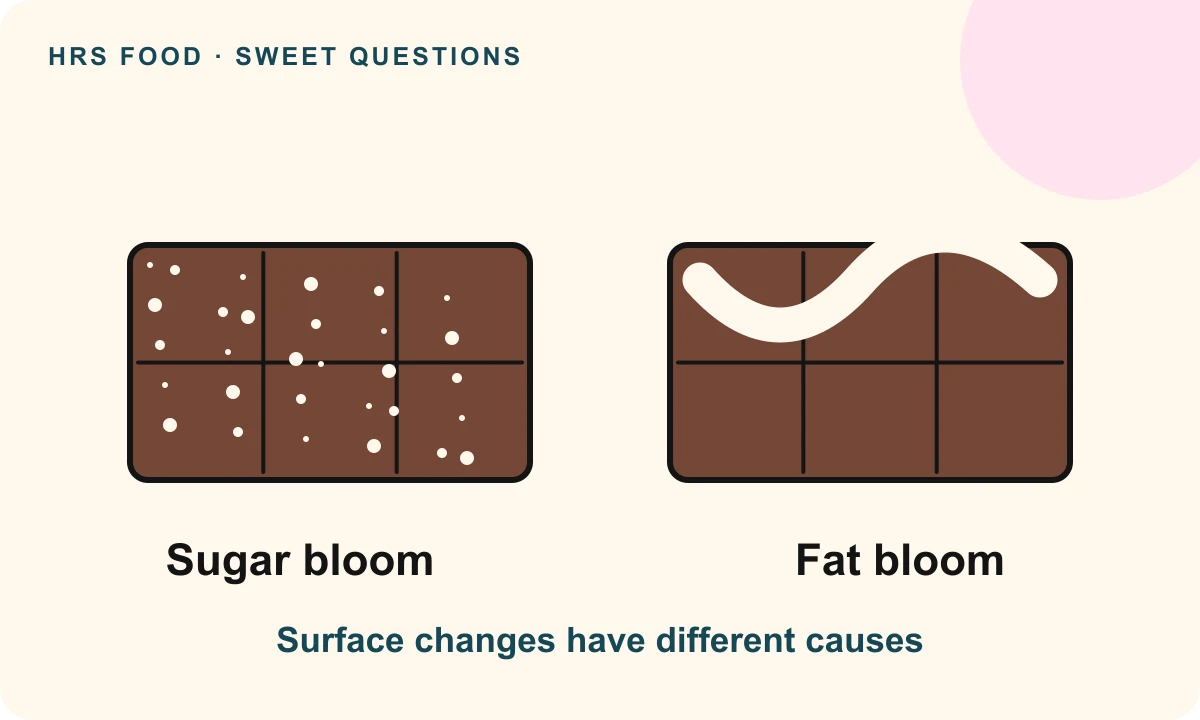
Fat bloom is a change in the fat
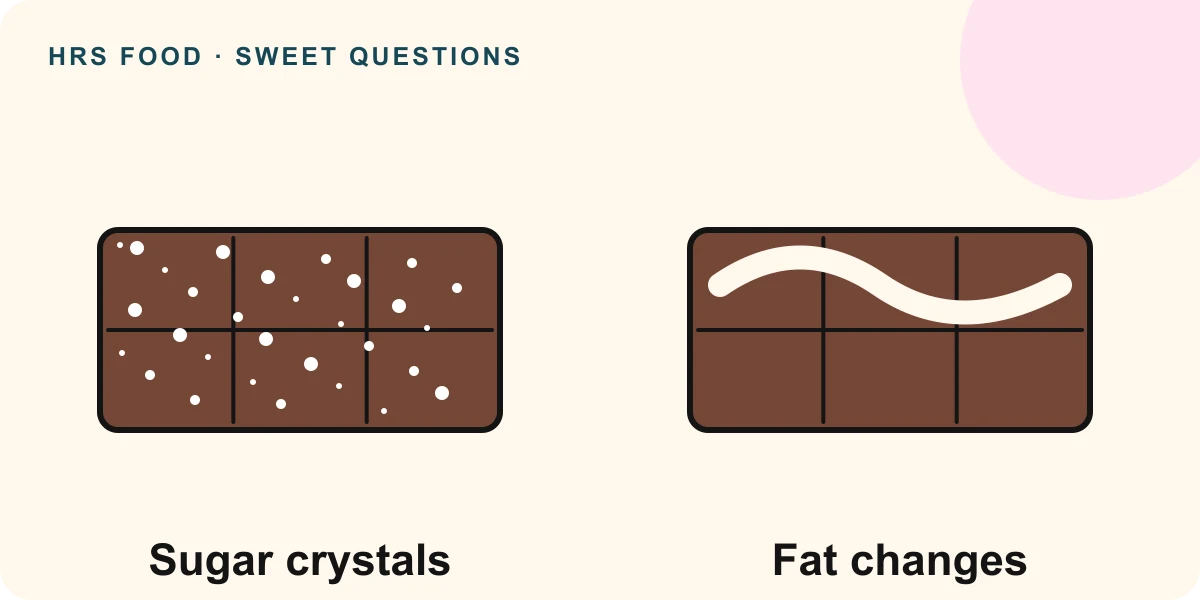
Cocoa butter forms crystals as chocolate sets. Unfavourable crystallisation, warmth, temperature swings or fat migrating from a filling can produce a pale surface. Callebaut identifies poor tempering, filling fats and storage conditions as important causes of fat bloom.
That pale layer can make a bar look dusty or streaked even though no flour has been sprinkled over it. It is a change in the chocolate’s structure. [1]
Sugar bloom involves moisture
Sugar bloom starts with water at the surface. Moisture dissolves some sugar; after that moisture evaporates, sugar crystals remain. The resulting surface can look pale and feel rough or grainy.
This explains why moving cold chocolate into humid air can be troublesome: condensation supplies the water. A white mark is not automatically a sign that the cocoa butter has melted. [2]
Moisture arrives
A little surface water dissolves sugar.
Water leaves
The moisture evaporates.
Crystals remain
Sugar leaves a rough pale coating.
How it works [2]
Does white chocolate bloom mean the bar is unsafe?
Bloom describes a quality defect, not a complete safety assessment. You cannot identify every white patch as bloom from colour alone. Mould, damaged packaging, unsuitable storage and perishable fillings need separate consideration.
Follow the product’s storage instructions and date marking. A use-by date concerns safety, while a best-before date concerns quality. If you cannot establish what has happened, do not rely on the phrase “it is only bloom” as a reason to eat it. [3]
How to reduce the chance of bloom
Aim for the cool, dry and stable storage conditions recommended on the packet. Protect chocolate from heat and repeated temperature changes. Keep it sealed from moisture and strong surrounding odours.
A fridge is not a universal fix: condensation during temperature changes can create another problem. For filled chocolates, follow the maker’s instructions for that filling rather than assuming every chocolate product has the same storage life. [2]
At a glance
| What you notice | What explains it |
|---|---|
| Fat bloom | A pale surface associated with fat migration or crystallisation. |
| Sugar bloom | Surface sugar dissolves and recrystallises after moisture exposure. |
| A white patch of unknown origin | Appearance alone cannot establish its cause or safety. |
For the underlying explanation [1]
Common questions
Does bloom happen only to old chocolate?
No. Poor tempering or unsuitable storage can bring it on much earlier. [1]
Can you diagnose bloom from a photograph?
A photograph can suggest possibilities, but it cannot establish the whole storage history or rule out spoilage. [3]
Should every chocolate bar go in the fridge?
Use its storage instructions. Avoid temperature changes that leave condensation on the surface. [2]
Sources and how we checked
Written by HRS Food using the sources below. Information checked on . Product examples refer to the named declaration, not every brand or recipe. Use the current pack for ingredients and allergens.
- Callebaut: causes of fat bloom
- Callebaut: storage and prevention of fat and sugar bloom
- UK Government: best-before and use-by dates
Original HRS explanatory illustrations. Shapes and layouts are simplified to show the idea; they are not product photographs or manufacturing specifications.