By HRS Food · Published · Reviewed
Why do taffy and soft caramel stretch?
The short answer
Taffy and soft caramel can stretch because their sugar-rich structure can deform and flow rather than breaking immediately. Water content, temperature and recipe determine how soft that structure is. Pulling taffy also introduces air, but air is not the whole explanation for why a sweet stretches. [1]
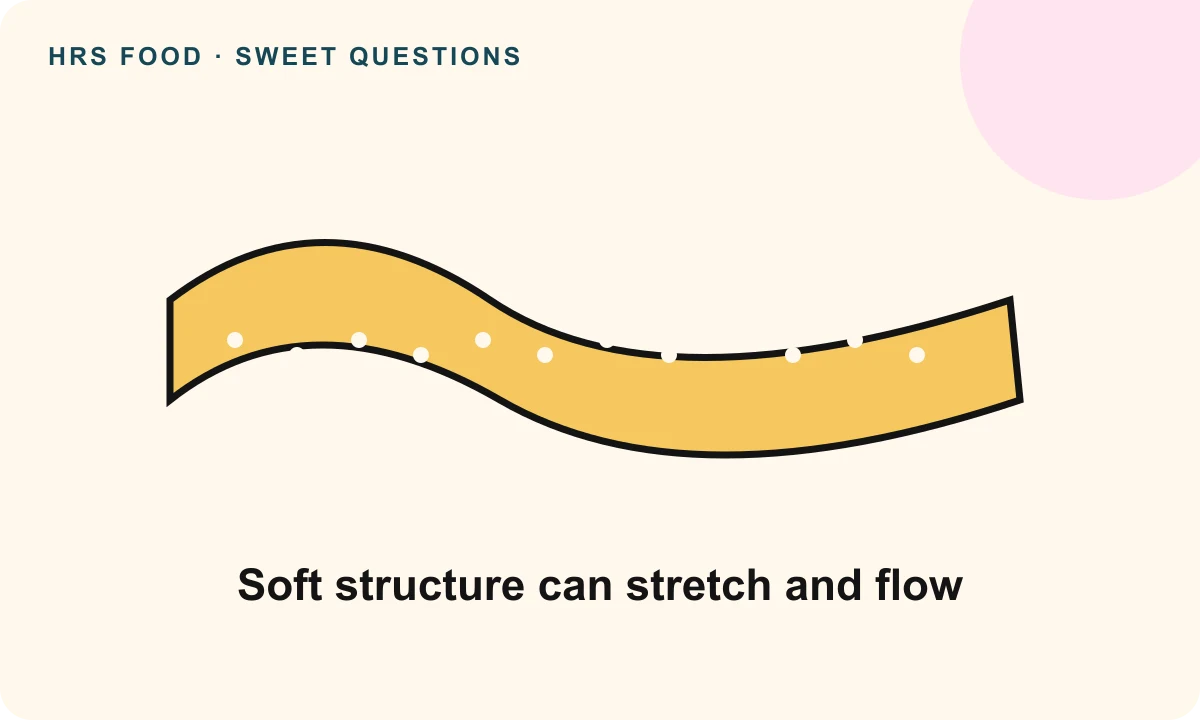
A sweet can behave partly like a solid and partly like a liquid
Scientists describe materials with both elastic and flowing behaviour as viscoelastic. A soft caramel can hold its shape briefly but slowly deform under a pull. Research using caramel as a test material shows how its response changes with moisture and the rate of deformation.
The distinction is time-dependent: how hard and how quickly you pull matters, not just how the sweet looks at rest. [1]
Water and temperature change the texture
The final moisture level affects how mobile the sugar-rich structure is. Temperature also changes how readily it deforms. A cold caramel and the same caramel warmed in your mouth can therefore feel quite different.
That does not mean every warm sweet becomes stretchy. The formulation and physical state still matter; a hard boiled sweet and a soft caramel start with different structures. [1]
Structure
Recipe and moisture set the material’s behaviour.
Conditions
Warmth and pulling speed change its response.
Air
Aeration changes taffy’s density and bite.
How it works [1]
Why taffy is pulled or whipped
Stretching and folding traditional taffy incorporates small air bubbles, changing its density and bite. The Exploratorium describes this aeration as a reason taffy becomes lighter and chewier.
Not every maker aerates in exactly that way. Taffy Town describes whipping its taffy in a mixer rather than relying on a conventional pulling machine. The production method and texture are related, but the words “pulled taffy” do not describe every factory. [2][3]
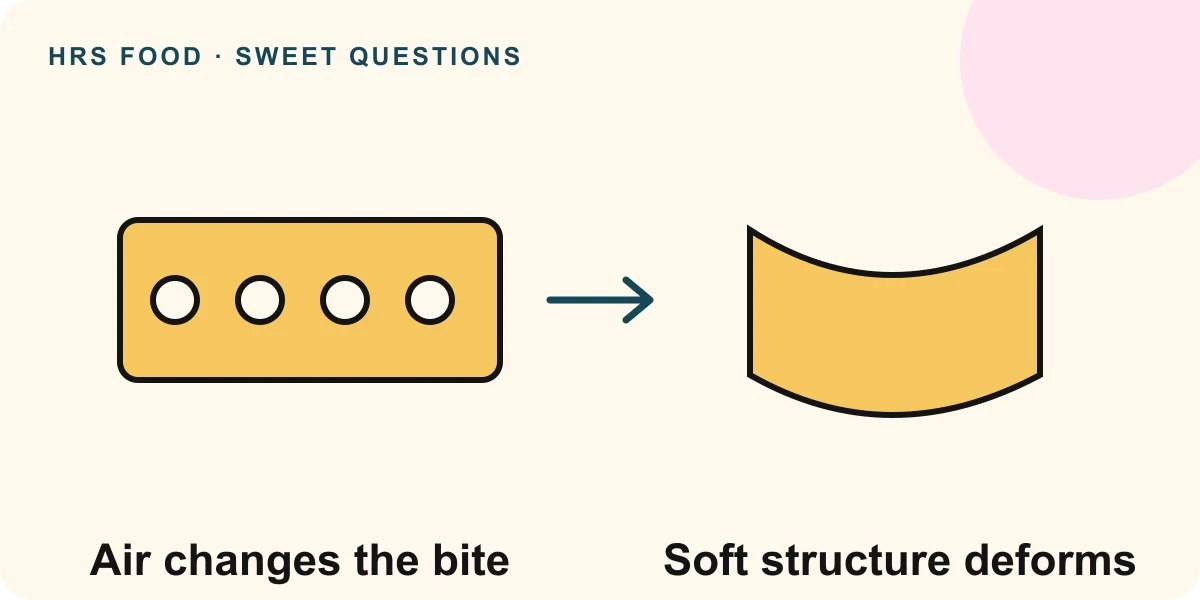
Taffy and caramel do not need the same recipe
Caramel commonly includes milk ingredients and fat alongside sugars and water. Taffy formulations and aeration methods vary. Their stretch can look similar without either needing the same gelling system as a gummy sweet.
“Salt water taffy” also does not mean the sweet is made with seawater. Compare the actual ingredients and texture rather than reading a manufacturing instruction into the traditional name. [1][2]
At a glance
| What you notice | What explains it |
|---|---|
| Pulled taffy | Repeated folding can incorporate air. |
| Whipped taffy | A mixer can provide the aeration. |
| Soft caramel | Recipe, moisture and temperature govern deformation. |
For the underlying explanation [3]
Common questions
Is stretch always caused by gelatine?
No. A soft sugar-based confection can deform without using the gelatine system of a gummy. Check its actual recipe. [1]
Does salt water taffy contain seawater?
The traditional name does not mean it is made from ocean water. [2]
Why is cold caramel harder to stretch?
Temperature affects the mobility and deformation of its structure; the recipe also matters. [1]
Sources and how we checked
Written by HRS Food using the sources below. Information checked on . Product examples refer to the named declaration, not every brand or recipe. Use the current pack for ingredients and allergens.
- Primary research: caramel as a viscoelastic material
- Exploratorium: pulling, aeration and salt water taffy
- Taffy Town: pulling versus its whipped process
Original HRS explanatory illustrations. Shapes and layouts are simplified to show the idea; they are not product photographs or manufacturing specifications.