By HRS Food · Reviewed
Why does popping candy pop on your tongue?
The short answer
Popping candy contains tiny pockets of carbon dioxide gas trapped under pressure inside hard candy. As saliva dissolves the candy around those pockets, the gas escapes with a crackle. Pop Rocks is a brand of popping candy; its pop is mainly a release of trapped gas, rather than a new gas-making reaction on your tongue. [1]
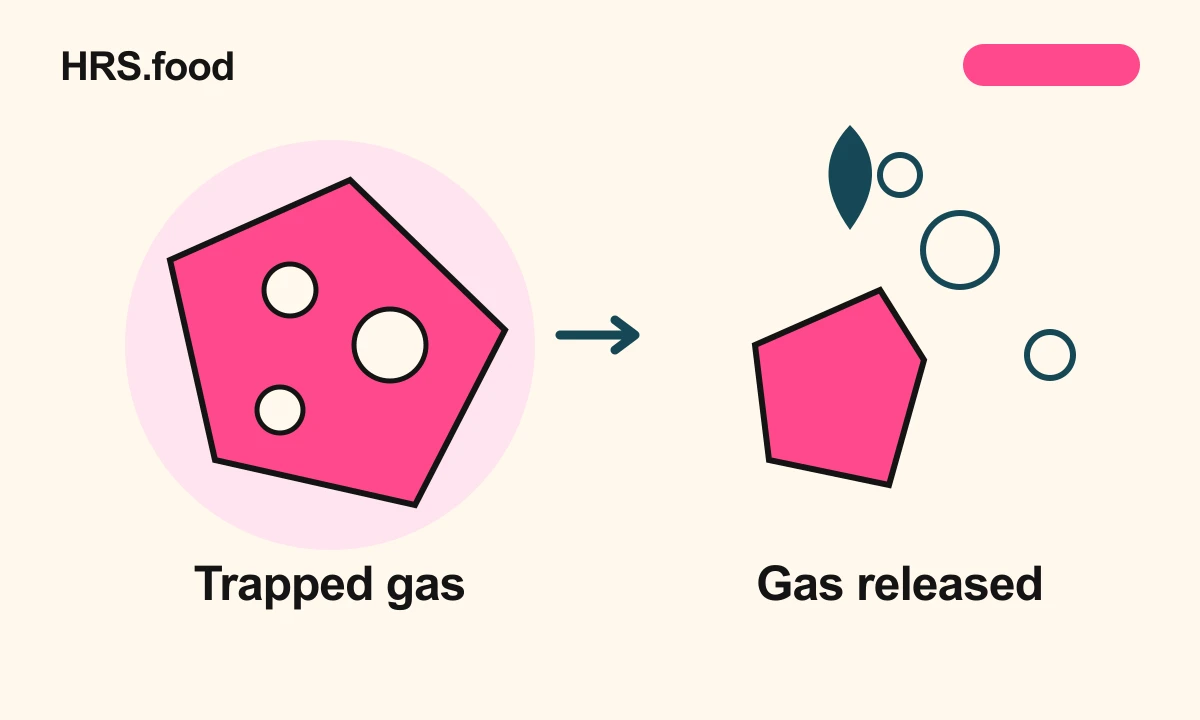
The gas is put there during manufacture
The original gasified-confection patent describes a hot sugar mixture exposed to gas under pressure, then cooled and solidified. Small gas pockets become enclosed in the candy. This is the principle behind the characteristic crackle.
That explains why a dry crystal can look fairly ordinary. Its special feature is inside. The effect does not depend on adding a second ingredient at home, and a coating of ordinary sugar would not automatically make another sweet pop. [3]
What changes when it touches your tongue?
The POP ROCKS manufacturer identifies the trapped gas as the source of the sensation. In your mouth, moisture breaks down the candy surrounding the pockets, letting the gas escape. You can both feel and hear the little releases.
The word explode describes the surprise of the crackle, but it can give the wrong impression of what is happening. These are tiny gas pockets opening, not flames or a combustion reaction. The illustration enlarges the bubbles so the mechanism is easier to see. [1]
During production
Gas is introduced under pressure.
Dry hard candy
Tiny gas pockets remain trapped.
In your mouth
Candy dissolves and the gas escapes.
How it works [1]
Popping candy and sherbet fizz work differently
Both can involve carbon dioxide, which is why the sensations get grouped together. In sherbet, an acid and bicarbonate can react when moisture is added, producing gas. In popping candy, gas introduced during production is already trapped inside the sweet.
This difference is useful when comparing products. Sour describes a taste; popping describes the trapped-gas effect. A product can combine more than one feature, so use the exact description rather than assuming every sour or fizzy sweet contains popping crystals. [2]
Why the packet needs to stay dry
Moisture can start releasing the gas before the candy reaches your mouth. If you want a crackling topping on a dessert, add it close to serving rather than stirring it into a wet mixture long in advance. The effect may already be spent by the time you eat.
Follow the current packet’s storage and ingredient advice. Do not assume a product is dairy-free just because it looks like coloured sugar: ingredients can differ between brands and flavours. [4]
At a glance
| Sweet | Where the gas comes from |
|---|---|
| Popping candy | Carbon dioxide already trapped in the candy. |
| Sherbet | An acid–bicarbonate reaction when moistened. |
| A sour sweet | Sourness alone does not establish any gas-release mechanism. |
For the underlying explanation [2]
Common questions
Does popping candy need saliva specifically?
Moisture is the key to breaking down the candy around the gas pockets. A wet dessert can trigger the effect too, which is why timing matters for toppings. [4]
Are Pop Rocks and popping candy the same thing?
Pop Rocks is a brand name. Popping candy is the wider product description for sweets using this trapped-gas effect. [4]
Does the crackle mean the candy is burning?
No. The characteristic pop comes from pressurised carbon dioxide being released from the candy. [1]
Sources and how we checked
Written by HRS Food using the sources below. Information checked on . Product examples refer to the named declaration, not every brand or recipe. Use the current pack for ingredients and allergens.
- POP ROCKS: the manufacturer explains the trapped carbon dioxide
- Royal Society of Chemistry: making popping candy and comparing sherbet
- Original gasified-confection patent: trapping gas in hard candy
- POP ROCKS: moisture, gas and how the product works
Original HRS explanatory illustrations. Shapes and layouts are simplified to show the idea; they are not product photographs or manufacturing specifications.