By HRS Food · Reviewed
Do sweets and sugar make children hyperactive?
The short answer
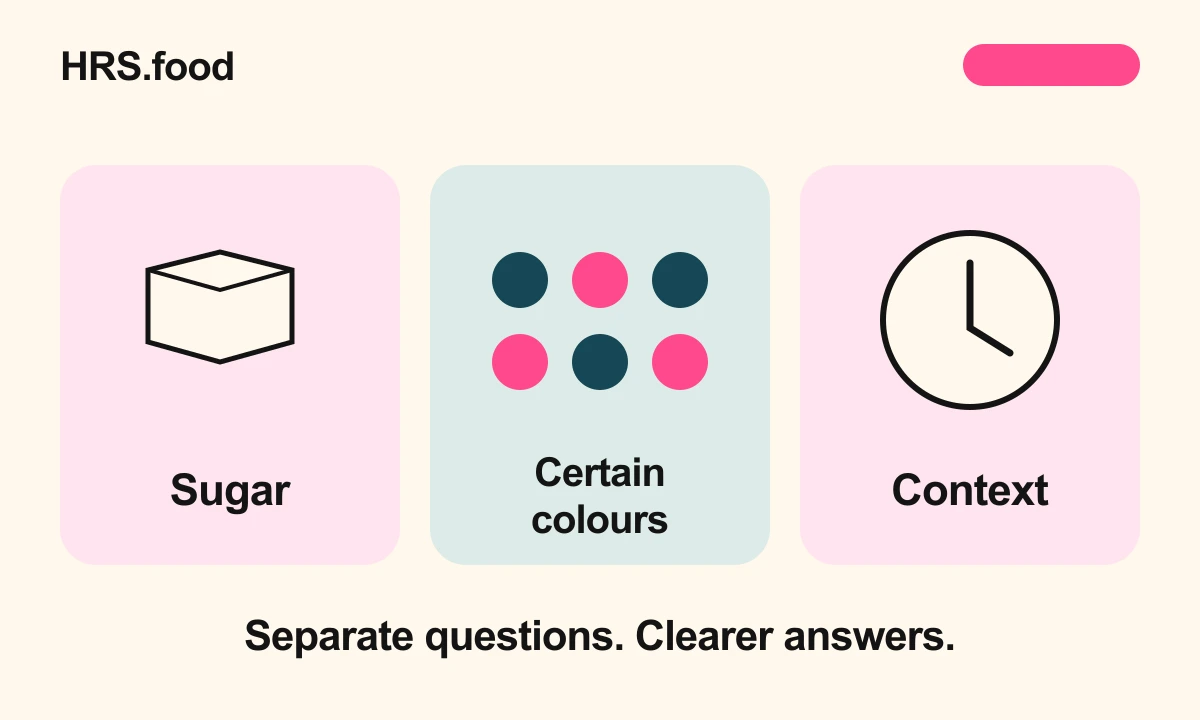
Controlled research does not support the familiar claim that sugar generally causes a burst of hyperactive behaviour in children. That does not mean diet never matters. Certain artificial food colours have separate evidence and warning requirements, and persistent behaviour or attention concerns deserve proper assessment rather than being labelled a sugar rush. [1][2]
What did controlled sugar studies find?
A JAMA meta-analysis examined blinded, placebo-controlled studies of sugar and children’s behaviour or cognitive performance. It did not find an overall effect supporting the usual sugar-rush story. The authors also noted that small effects or effects in particular groups could not be ruled out.
This is an older body of research, not a new test of every sweet sold today. Its value is that the studies tried to separate sugar itself from expectations. It does not justify promising that every child will react identically, or that eating sweets has no other health consequences. [1]
Why can the sugar-rush explanation feel so convincing?
At a birthday party, sweets can arrive alongside excitement, games and a changed routine. Activity afterwards does not isolate the cause. This illustrates the problem; it does not explain any particular child. Researchers also discuss expectation and the common association between sugar and excitement. [1]
Observe
Record the food, timing and behaviour.
Check the pack
Separate sugar from colours and other ingredients.
Discuss patterns
Ask a GP before restricting a child’s diet.
How it works [4]
Food colours are a different issue
UK guidance identifies six colours associated with possible effects on activity and attention in children: E102, E104, E110, E122, E124 and E129. Food and drink containing these colours generally have to carry the relevant warning. That is a colour issue, not proof that sugar itself causes hyperactivity.
The NHS says the relationship is not completely certain, that avoiding colours will not necessarily improve behaviour, and that you do not need to avoid every E number. Read the actual ingredients and warning on a pack rather than judging by how colourful a sweet looks. [2][3]
What to do if you notice a pattern
NICE recommends asking about foods or drinks that appear to affect hyperactive behaviour. Where there is a clear possible link, a food-and-behaviour diary can support discussion with a healthcare professional and, when appropriate, a dietitian.
NICE does not recommend removing artificial colours and additives as a generally applicable ADHD treatment. Speak with your child’s GP before making restrictive dietary changes. Persistent difficulties with attention, impulsivity or activity should be discussed on their own merits, rather than assumed to be caused by sweets. [4][3]
Sugar still matters for other reasons
The absence of a proven general sugar rush is not a recommendation to offer unlimited sweets. NHS guidance links free sugars with tooth decay and excess intake, and advises limiting sugary foods and drinks to mealtimes for dental health.
A practical approach is to keep portions and frequency sensible, preserve regular meals and sleep routines, and use professional advice for persistent concerns. You do not need a sugar-rush story to explain why sweets are an occasional food. [5]
At a glance
| Claim | What the evidence supports |
|---|---|
| Sugar generally causes hyperactivity | Controlled studies do not support the usual claim. |
| Certain food colours may affect activity | A separate issue addressed in NHS and UK food guidance. |
| Removing additives treats all ADHD | Not recommended as a general treatment by NICE. |
For the underlying explanation [4]
Common questions
Does this mean my observations are wrong?
No. A pattern is worth discussing. A diary helps separate the sweet, its other ingredients and the situation instead of assuming one cause. [4]
Should I remove all E numbers?
No. The NHS says most E numbers are not linked to hyperactivity. Discuss a suspected food-and-behaviour link with your child’s GP first. [3]
Is unlimited sugar fine if it does not cause a sugar rush?
No. Sugar intake still matters for dental health and a balanced diet. The behavioural claim and the nutritional advice are different questions. [5]
Sources and how we checked
Written by HRS Food using the sources below. Information checked on . Product examples refer to the named declaration, not every brand or recipe. Use the current pack for ingredients and allergens. This is general information, not a diagnosis or an individual medical assessment.
- JAMA meta-analysis: sugar, behaviour and cognition in children (1995)
- UK food-additive guidance: the six colours and warnings
- NHS: food colours and hyperactivity
- NICE ADHD guideline NG87: dietary advice, section 1.6
- NHS: sugar and health
Original HRS explanatory illustrations. Shapes and layouts are simplified to show the idea; they are not product photographs or manufacturing specifications.