By HRS Food · Published · Reviewed
Why does candy floss disappear in water?
The short answer
Candy floss, also called cotton candy, contains extremely fine sugar threads with lots of air between them. Water dissolves the threads quickly, collapsing the fluffy structure. The sugar is still in the water: it has dissolved rather than vanished or lost its sugar content. [1]
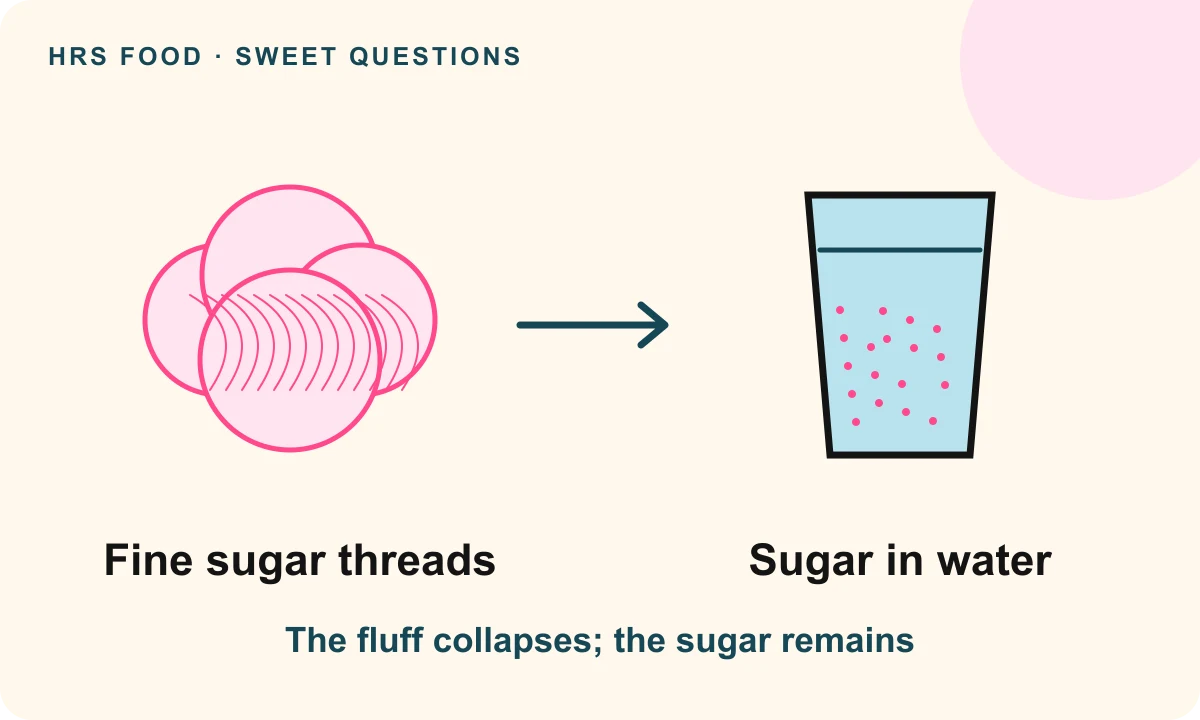
Most of the cloud is space
Candy floss is a loose structure of thin spun-sugar strands. Air between them makes a portion look much bulkier than a compact lump containing the same sugar.
Imagine a loosely tangled ball of fine thread. Remove the threads and the structure disappears, even though the space it occupied was never solid material. [1]
Thin threads give water access
Sugar dissolves in water. Fine threads expose more of their material directly to the water than a compact lump does. They also have little thickness for the water to work through.
The combination makes the collapse look almost instant. A sugar cube has a more substantial structure to break down, even though its sugar can dissolve too. [2]
Threads
Sugar strands hold air between them.
Contact
Water dissolves the exposed sugar.
Collapse
The fluff is gone; sugar remains in solution.
How it works [2]
Dissolving is different from melting
Melting changes a solid into a liquid through a temperature change. Dissolving disperses a substance into a solvent, such as sugar into water. Ordinary room-temperature water can collapse candy floss without heating it into molten sugar.
A glass can look almost clear afterwards because the dissolved sugar is no longer present as visible fluffy threads. It is still part of the drink. [3]

Why damp air shrinks it too
Liquid water makes the effect obvious, but humidity can affect candy floss as well. Research has examined how temperature and relative humidity alter its physical state. That is why protecting the airy structure from moisture matters.
For a simple observation, use a small pinch and ordinary drinking water. There is no need for hot sugar or boiling water. Watch the volume collapse rather than expecting the sugar to cease to exist. [1]
At a glance
| What you notice | What explains it |
|---|---|
| Floss in water | Dissolving collapses the airy structure. |
| Sugar heated until liquid | Melting involves a temperature change. |
| Floss in humid air | Moisture can destabilise its dry structure. |
For the underlying explanation [1]
Common questions
Does the sugar disappear?
No. The visible threads disappear as sugar dissolves into water. [3]
Is cotton candy different from candy floss?
These are common names for the same type of spun-sugar confectionery. [1]
Does it need hot water?
No. Ordinary water dissolves sugar; fine threads make contact and collapse rapid. [2]
Sources and how we checked
Written by HRS Food using the sources below. Information checked on . Product examples refer to the named declaration, not every brand or recipe. Use the current pack for ingredients and allergens.
- Labuza and Labuza: physical states of cotton candy
- American Chemical Society: dissolving sugar
- Exploratorium: sugar solutions
Original HRS explanatory illustrations. Shapes and layouts are simplified to show the idea; they are not product photographs or manufacturing specifications.