By HRS Food · Published · Reviewed
How are the letters printed on M&M’s and Smarties?
The short answer
The “m” on M&M’s is a printed edible mark, rather than a letter carved into every shell. Food printing can use contact transfer or precisely placed ink droplets. Smarties are a different product: a Nestlé patent documents printing trials on Smarties, but that does not mean every Smartie has a printed design. [1]
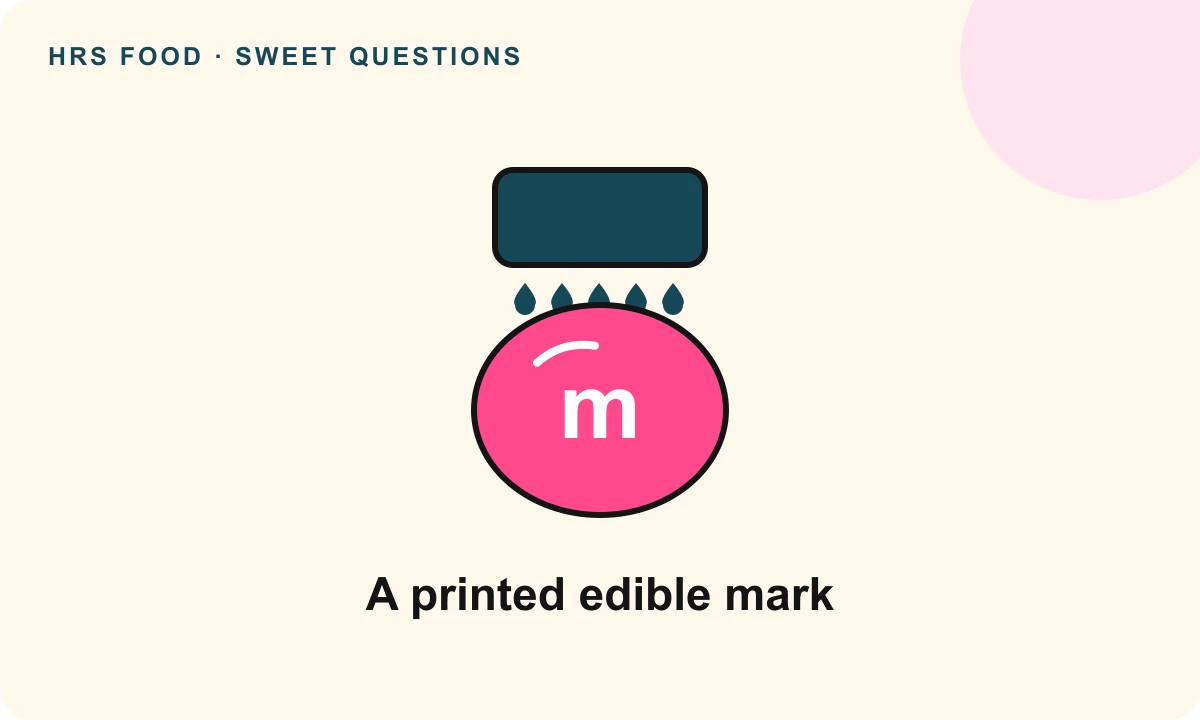
The mark sits on the surface
Food-grade inks put a visible design on a sweet’s exterior. A Mars patent explicitly discusses printed images on sugar-shell confectionery, including M&M’s. The idea is closer to printing a label directly onto a curved surface than cutting a letter out of the candy.
The ink has to suit food and the surface being printed. An ordinary office ink cartridge is not an alternative. [1]
How can small marks stay consistent?
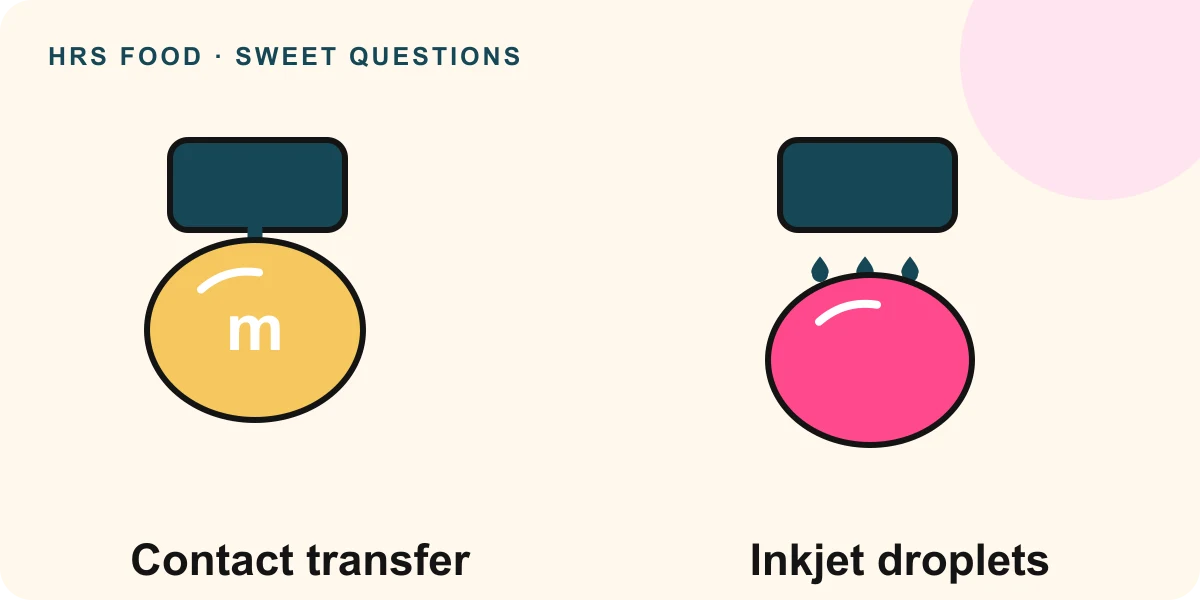
Contact systems transfer an image using a pad or roller; inkjet systems place droplets without that contact. Repeating a controlled design and controlling how the sweet meets the printing system help make the marks consistent.
The Mars patent contrasts these methods. It does not establish that every current line or every personalised M&M uses identical equipment. [1]
Position
Present the sweet to the printing system.
Print
Transfer food ink or place controlled droplets.
Set
Keep the image distinct as the ink dries.
How it works [1]
Why a glossy shell is a printing challenge
Water-based ink can bead or smear on a water-repelling finish. Nestlé’s published research patent describes inkjet trials on wax-finished Smarties and compares how different inks held their shape.
Clear printing therefore depends on the pairing of ink and surface, not just making the printer smaller. This is a documented technical challenge with small coated sweets. [2]
M&M’s and Smarties need separate answers
M&M’s familiar letter is not a feature to assume on every other chocolate button. The Nestlé patent establishes printing experiments on Smarties; it does not prove a particular design is standard on today’s UK pack.
There is another naming trap: American Smarties are pressed candy tablets, whereas Nestlé Smarties are chocolate confectionery. When checking ingredients or manufacturing, identify the exact product first. [2][3]
At a glance
| What you notice | What explains it |
|---|---|
| Pad or roller transfer | A contact member transfers the design. |
| Inkjet | Droplets form the image without a printing pad. |
| A manufacturing patent | Evidence of a method or trial, not every current factory line. |
For the underlying explanation [2]
Common questions
Is the M carved into the shell?
It is a surface print. Food printing puts an edible image onto the sweet. [1]
Does every Smartie have a printed letter?
Do not assume that. Nestlé’s printing patent describes trials, rather than a universal feature of current products. [2]
Are American Smarties chocolate?
The familiar US Smarties Candy Company product is a pressed candy tablet, different from Nestlé chocolate Smarties. [3]
Sources and how we checked
Written by HRS Food using the sources below. Information checked on . Product examples refer to the named declaration, not every brand or recipe. Use the current pack for ingredients and allergens.
- Mars patent: printing on sugar-shell confectionery
- Nestec patent: edible inkjet printing trials on Smarties
- Smarties Candy Company: US tablet product
Original HRS explanatory illustrations. Shapes and layouts are simplified to show the idea; they are not product photographs or manufacturing specifications.