By HRS Food · Published · Reviewed
How do sweets and liqueur chocolates get liquid centres?
The short answer
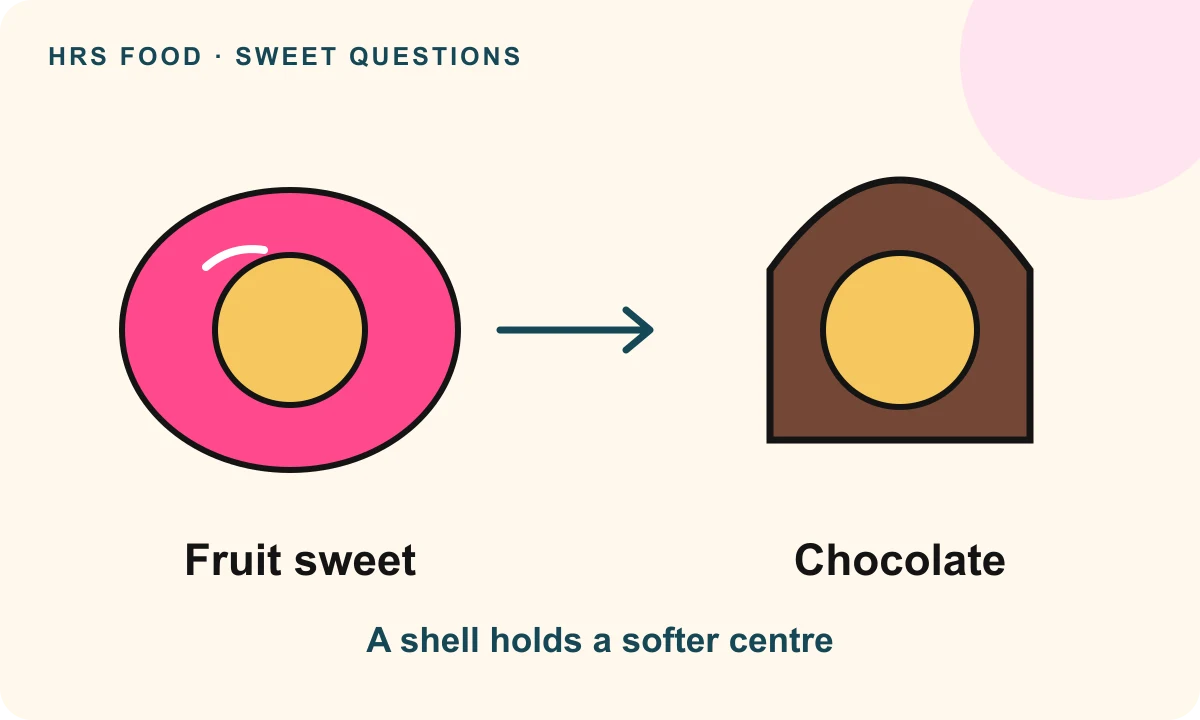
Liquid-centred sweets are made by enclosing a softer filling inside an outer layer that can hold it. Some systems deposit the outside and centre together; chocolates may be filled in a mould or use a sugar-crust centre. There is no single process for every brand. Gushers belong to General Mills, rather than Rowntree’s. [1]
First, which sweet are we talking about?
Gushers are fruit-flavoured snacks that General Mills describes as having a chewy outer shell and liquid centre. Calling them Rowntree’s Fruit Gushers mixes two different brand names. The distinction matters because finding the correct maker is the first step towards checking a recipe or production claim.
The useful underlying question is the same: how can the outside remain intact while the inside stays runny? [1]
How a centre can be enclosed as the sweet forms
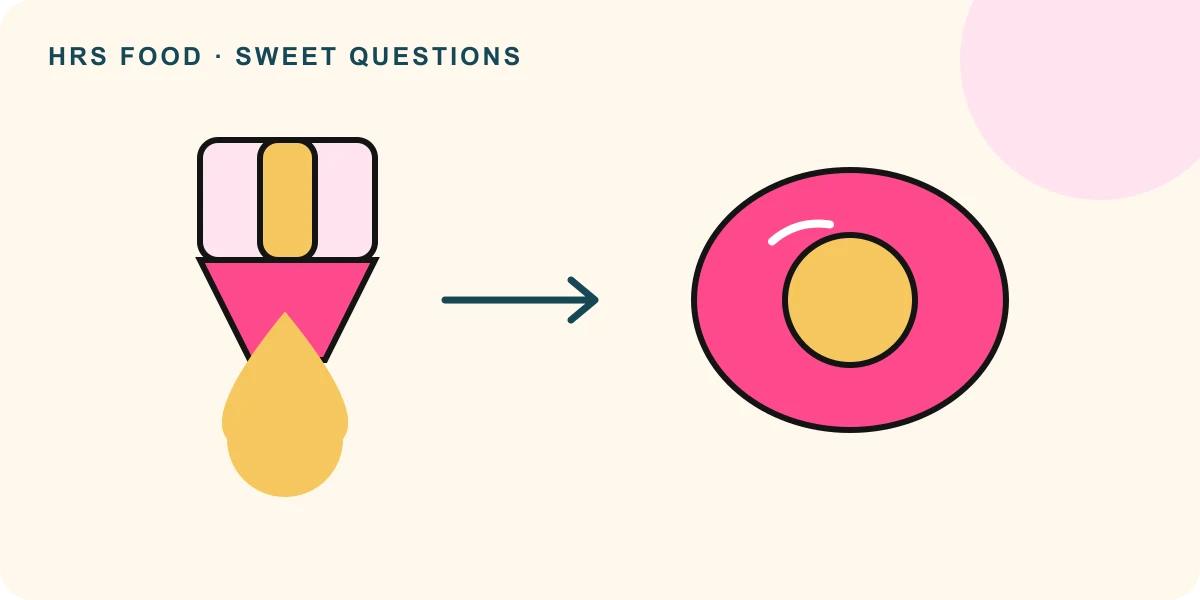
One documented approach is co-depositing. A nozzle has an outer stream for the shell mixture and an inner stream for the filling. Their timing lets the outside surround the centre; the shell then sets into a supporting layer.
A published fruit-snack patent describes this arrangement. It illustrates a real confectionery method, but it is not proof that the current Gushers factory uses that patent or the same equipment. [2]
Two mixtures
Prepare an outer mixture and a separate filling.
Deposit together
An inner stream sits inside an outer stream.
Set the shell
The outside firms while enclosing the softer centre.
How it works [2]
Liquid chocolate centres can take another route
A chocolate shell can be formed in a mould, receive a filling and then be closed. A different traditional approach creates a thin sugar crust around a syrup centre before the centre receives its chocolate coating. A published sugar-shell patent documents that principle.
These structures look similar when bitten, but the manufacturing steps are different. A liqueur centre also needs its actual product label checked for alcohol; a liquid texture alone does not tell you what it contains. [3]
Why does the centre not simply soak through?
The filling and outside have to work as a pair. The fruit-snack patent discusses controlling water in the centre so it remains fluid without leaking through the gelled shell. Sealing and the relationship between the mixtures matter as much as putting syrup in the middle.
Think of a filled sweet as an engineered little container. A cutaway explains its structure; it cannot reveal a manufacturer’s complete recipe or every production setting. [2]
At a glance
| What you notice | What explains it |
|---|---|
| Co-deposited fruit sweet | The outside and filling are placed together. |
| Moulded chocolate | A chocolate shell can receive a filling before closure. |
| Sugar-crust chocolate | A thin sugar structure contains syrup beneath the chocolate. |
For the underlying explanation [3]
Common questions
Are Gushers a Rowntree’s product?
No. The Gushers product information used here is from General Mills. [1]
Do manufacturers drill a hole in every finished sweet?
They do not need to: a documented alternative encloses the filling while forming the outside. The exact method is product specific. [2]
Does a patent reveal a brand’s current factory process?
Not by itself. It establishes a described method, not that a particular current product uses it. [2]
Sources and how we checked
Written by HRS Food using the sources below. Information checked on . Product examples refer to the named declaration, not every brand or recipe. Use the current pack for ingredients and allergens.
- General Mills: Gushers Flavor Mixers product description
- Published patent: co-deposited juice-filled fruit snacks
- Published patent: sugar shells for filled liqueur chocolates
- Published patent: alternative liquid-centre confectionery methods
Original HRS explanatory illustrations. Shapes and layouts are simplified to show the idea; they are not product photographs or manufacturing specifications.